Every monitoring tool sells you the same thing. A dashboard. You open it, you scroll, you promise yourself you'll keep up. Two weeks later you stop opening it.
Sound familiar? The dashboard was never the point. The point is the handful of conversations happening right now where you could be useful, and those rot in a browser tab you forgot to check.
I run GTM for Tabstack, so this as an actual problem I needed to solve. I need to know when someone mentions us, when someone's frustrated with a tool in our space, when there's a question I can help with. But those few conversations sit buried under hundreds that look relevant and aren't. That's the work: cutting the noise down to what matters, then replying before it goes cold. Neither half scales by adding another tab to your morning.
So I'd already taken a swing at it. My Hermes GTM agent runs a community signals report every morning before I'm even at my desk. It works. But on its own, it leaned toward housekeeping tasks: which PR merged, which repo pushed overnight. The conversations I actually wanted stayed the thinnest slice of the report, because raw keywords drown them in noise.
Then MentionDrop shipped an MCP. I wired it into Hermes this week, and the report I re-ran was completely different.
What the MCP actually changes
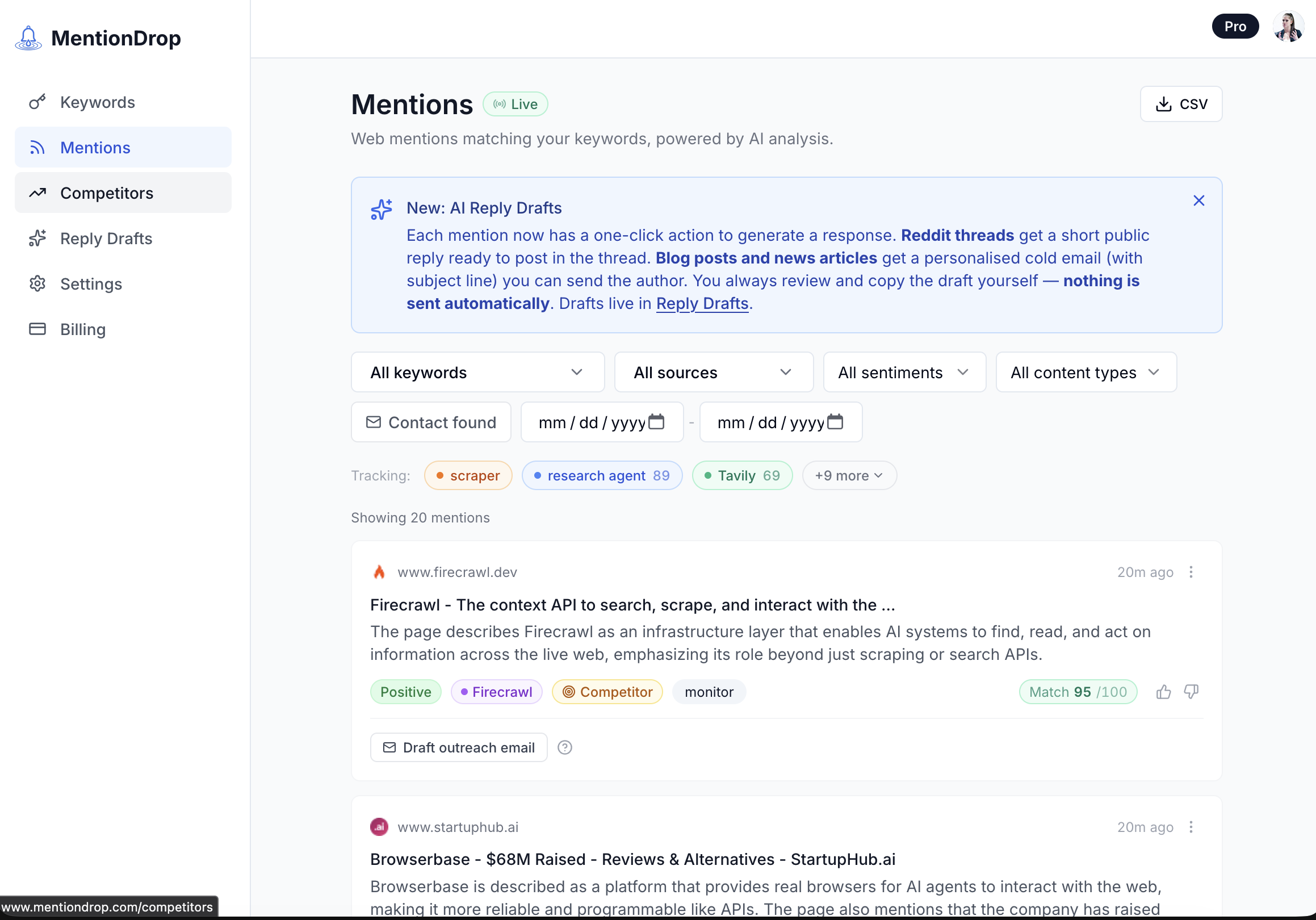
MentionDrop has always done the hard part, filtering social noise into real signal. The MCP changes how you use it. Instead of a dashboard I visit, it becomes a set of tools my agent calls directly: the same filtered data, exposed so Hermes can pull it without me clicking anything.
That's the whole shift. A tool with an MCP doesn't have to be a place you go. It can be a capability your agent has.
Connecting it took about two minutes. The tuning came after. A broad keyword pulls in everything at first; one of mine was matching a soccer player, an obituary, and a makeup app. What sold me is how much control MentionDrop hands you to fix that. Every keyword takes a role, a context sentence, a relevance floor, and exclusion terms. A few minutes turned a messy feed into a high-signal one, and because the filter learns from what I mark reviewed, tomorrow's run will be sharper than today's.
Here's the division of labor I landed on: MentionDrop does the filtering, Hermes pulls what's left into one morning list and drafts a reply for each in my voice. But Hermes can't touch my account or post anything in public. That part is mine. I read the draft, make my edits, and hit post. Every draft also clears my editorial principles before it reaches me, so what I'm reviewing already sounds like me.
What I actually get now
A short list each morning. Five or six conversations, not five hundred. Each one comes with a line on why it matters, a direct link, and a reply already drafted the way I'd say it.
Here's one from today's run. Hermes flagged a developer on r/ClaudeAI stuck trying to install Apify, the kind of friction moment where an alternative is genuinely welcome. It pulled the thread, noted why it mattered, and wrote the draft:
Apify's MCP setup can be pretty finicky, the actor runtime adds a bunch of overhead that doesn't play nicely with Claude's tool calling in every setup.
If you're trying to pull structured data or do browser-based research, you might find Tabstack's API simpler to wire up. It's a plain REST API with no runtime to configure. Happy to share a quick example if you tell me what you're trying to extract.
I read it, removed spaces around the em dashes, and hit post. Done in 3o seconds.
Compare that to what Hermes gave me on its own a few days ago: a thorough rundown of GitHub activity. Which issues got acknowledged, which PR was blocking a launch, which repo pushed overnight. All true, all useful for ops. But not one conversation I could go be useful in. That report was a status update. This one's a revenue-driving to-do list.
"MentionDrop's MCP turns my Hermes agent's morning report from a status update into a revenue-driving to-do list."
The bottom line
I only set this up this week, so I won't pretend it has remade everything. But the first real run handed me a list worth acting on, and that's the part that has me hooked. The tool didn't change. MentionDrop was already good at the filtering. What changed is that it shipped an MCP, and that turned it from something I check into something my agent runs for me.
That's what I keep coming back to. My agent was already doing the work. It just needed better inputs. An MCP is how a good tool stops being a destination and becomes a capability.

Every monitoring tool sells you the same thing. A dashboard. You open it, you scroll, you promise yourself you'll keep up. Two weeks later you stop opening it.
Sound familiar? The dashboard was never the point. The point is the handful of conversations happening right now where you could be useful, and those rot in a browser tab you forgot to check.
I run GTM for Tabstack, so this as an actual problem I needed to solve. I need to know when someone mentions us, when someone's frustrated with a tool in our space, when there's a question I can help with. But those few conversations sit buried under hundreds that look relevant and aren't. That's the work: cutting the noise down to what matters, then replying before it goes cold. Neither half scales by adding another tab to your morning.
So I'd already taken a swing at it. My Hermes GTM agent runs a community signals report every morning before I'm even at my desk. It works. But on its own, it leaned toward housekeeping tasks: which PR merged, which repo pushed overnight. The conversations I actually wanted stayed the thinnest slice of the report, because raw keywords drown them in noise.
Then MentionDrop shipped an MCP. I wired it into Hermes this week, and the report I re-ran was completely different.
What the MCP actually changes
MentionDrop has always done the hard part, filtering social noise into real signal. The MCP changes how you use it. Instead of a dashboard I visit, it becomes a set of tools my agent calls directly: the same filtered data, exposed so Hermes can pull it without me clicking anything.
That's the whole shift. A tool with an MCP doesn't have to be a place you go. It can be a capability your agent has.
Connecting it took about two minutes. The tuning came after. A broad keyword pulls in everything at first; one of mine was matching a soccer player, an obituary, and a makeup app. What sold me is how much control MentionDrop hands you to fix that. Every keyword takes a role, a context sentence, a relevance floor, and exclusion terms. A few minutes turned a messy feed into a high-signal one, and because the filter learns from what I mark reviewed, tomorrow's run will be sharper than today's.
Here's the division of labor I landed on: MentionDrop does the filtering, Hermes pulls what's left into one morning list and drafts a reply for each in my voice. But Hermes can't touch my account or post anything in public. That part is mine. I read the draft, make my edits, and hit post. Every draft also clears my editorial principles before it reaches me, so what I'm reviewing already sounds like me.
What I actually get now
A short list each morning. Five or six conversations, not five hundred. Each one comes with a line on why it matters, a direct link, and a reply already drafted the way I'd say it.
Here's one from today's run. Hermes flagged a developer on r/ClaudeAI stuck trying to install Apify, the kind of friction moment where an alternative is genuinely welcome. It pulled the thread, noted why it mattered, and wrote the draft:
I read it, removed spaces around the em dashes, and hit post. Done in 3o seconds.
Compare that to what Hermes gave me on its own a few days ago: a thorough rundown of GitHub activity. Which issues got acknowledged, which PR was blocking a launch, which repo pushed overnight. All true, all useful for ops. But not one conversation I could go be useful in. That report was a status update. This one's a revenue-driving to-do list.
The bottom line
I only set this up this week, so I won't pretend it has remade everything. But the first real run handed me a list worth acting on, and that's the part that has me hooked. The tool didn't change. MentionDrop was already good at the filtering. What changed is that it shipped an MCP, and that turned it from something I check into something my agent runs for me.
That's what I keep coming back to. My agent was already doing the work. It just needed better inputs. An MCP is how a good tool stops being a destination and becomes a capability.
Read Next
How to Set Up Signup Attribution in PostHog Behind a Cookie Banner
Your cookie banner is hiding where your signups come from. PostHog never sees the page they landed on, so nearly all of them show up as direct. Here’s the fix, step by step, with all the code.
Dev Tool GTM, Done Agentically
My entire marketing operation at Tabstack is agentic, and I built it like an engineer. One source of truth in Quiver. Nothing hard-coded. Every context change versioned and approved. Agents do the work and I make the calls. Here's how it runs.
How to Make Claude Code Stop Writing Output Essays
I can't stand reading long output. Telling Claude Code to be concise doesn't work. Here are four ways to actually make it stick, ranked by how well they hold.
How I Grew Signups 71% in 90 Days by Running GTM Like an Engineer
I didn't run more campaigns. I built the systems that let me do the work of a team. Here's how running GTM like an engineer grew signups 71%.